
As an Amazon Associate Plantrella earns from qualifying purchases.
If you’re wondering whether you’ve missed the boat, you almost certainly haven’t. In the UK, garlic is usually planted from mid-autumn to early winter, and the RHS says most varieties need one to two months at 0–10°C to form a good, well-divided bulb. So a mid-November planting still gives your cloves the winter cold they need. The real limit is the state of your soil, not the date. If it’s frozen or waterlogged, wait for a better spell, or plant into pots or modules and move them out in spring.
Garlic is one of the easiest crops for a small garden, and it’s happy in a container. Below we cover the planting window, which type to buy, ground versus pots, a step-by-step guide and how to look after it until harvest.

Key takeaways
- Plant garlic from mid-autumn to early winter. Mid-November is fine if the soil isn’t frozen or sodden.
- Most varieties need a cold spell of one to two months at 0–10°C to split into cloves.
- Buy named varieties from a garden centre or seed supplier, not supermarket garlic.
- Pots need to be at least 25cm deep. Plant cloves 15cm apart with the tip 2.5cm below the surface.
- Heavy, wet soil? Start cloves in modules under cover and plant them out in spring.
Is November too late to plant garlic?
No. The RHS describes the usual planting window as mid-autumn to early winter, so November sits right in the middle of it. What matters is that the cloves get enough cold weather before spring. That cold spell is what triggers the bulb to divide into separate cloves. The RHS lists “not dividing into cloves” as a common problem, usually caused by too little cold over winter.
Two things are worth checking before you plant:
- Your soil. Garlic hates sitting wet. The RHS warns that wet soil makes garlic more prone to disease, especially when it’s planted in autumn. If your ground is heavy clay or puddles after rain, use pots or modules instead (more on that below).
- The weather. Don’t plant into frozen ground. A dry, mild spell later in the month is fine.
If you miss autumn altogether, some varieties are sold for planting in late winter and early spring. Check the packet. Spring-planted garlic is usually ready later, from mid-summer to early autumn, according to the RHS.
Which garlic should you buy?
Start with cloves from a named variety sold by a garden centre or a mail-order seed supplier. We’d go for ‘Solent Wight’, which the RHS rates as well suited to our climate. The RHS advises against planting supermarket garlic. It may not suit the British climate and there’s a risk of bringing in disease.
You’ll see two main types:
Hardneck garlic
According to the RHS, hardneck garlic produces fewer, larger cloves, has a stronger flavour and stores for about four to six months. It’s more likely to send up a flower stem, which you snap off (the young stems, called scapes, are good to cook with).
Softneck garlic
Softneck types have smaller, tightly packed cloves, rarely bolt and store for longer. The RHS says softneck garlic can keep for up to a year.
Varieties to look for
The RHS recommends looking for varieties with its Award of Garden Merit (AGM). Its current recommended list includes these softnecks:
- ‘Solent Wight’ AGM, described by the RHS as well adapted to the British climate and a good keeper.
- ‘Germidour’ AGM, a reliable softneck with large bulbs.
- ‘Cristo’ AGM, a white softneck with a strong flavour but a light aroma.
- ‘Arno’, a softneck with ivory-white skin that stores well.

- Solent Wight Garlic bulbs
- 40x Large seeds
- Nice flavour
A note on elephant garlic. It’s sold alongside garlic, but the RHS points out that it’s actually closer to leeks. It needs a long, warm growing season and is best planted in October, so a November planting is a little late for it.
Garlic in the ground, a raised bed or a pot?
All three work. Pick the one that suits your space and soil.
In the ground. This is best if you have a sunny bed with free-draining soil. Weed it first, then dig in well-rotted compost or manure. The RHS suggests about two bucketfuls per square metre.
In a raised bed. A raised bed is a good answer to heavy soil, because it drains more freely. Plant at the same spacing as in the ground.
In a pot. This is ideal for patios, balconies and gardens with soggy soil. The RHS says pots should be at least 25cm (10in) deep, filled with peat-free multi-purpose compost, with cloves at the same spacing and depth you’d use in the ground. The width of the pot decides how many cloves fit, so a wide trough holds more than a tall, narrow pot. Containers dry out faster than borders, so check them in dry spells, and stand them somewhere they won’t sit in winter rain.
In modules. If your soil is heavy or wet over winter, the RHS suggests starting cloves in module trays in autumn. Keep them in a cold frame, an unheated greenhouse or a sheltered spot, then plant them out in spring.
How to plant garlic, step by step
- Choose the sunniest spot you have. Garlic needs full sun and doesn’t like being shaded by weeds.
- Prepare the soil or fill your pot. Remove weeds and add organic matter to beds, or fill a deep pot with peat-free multi-purpose compost.
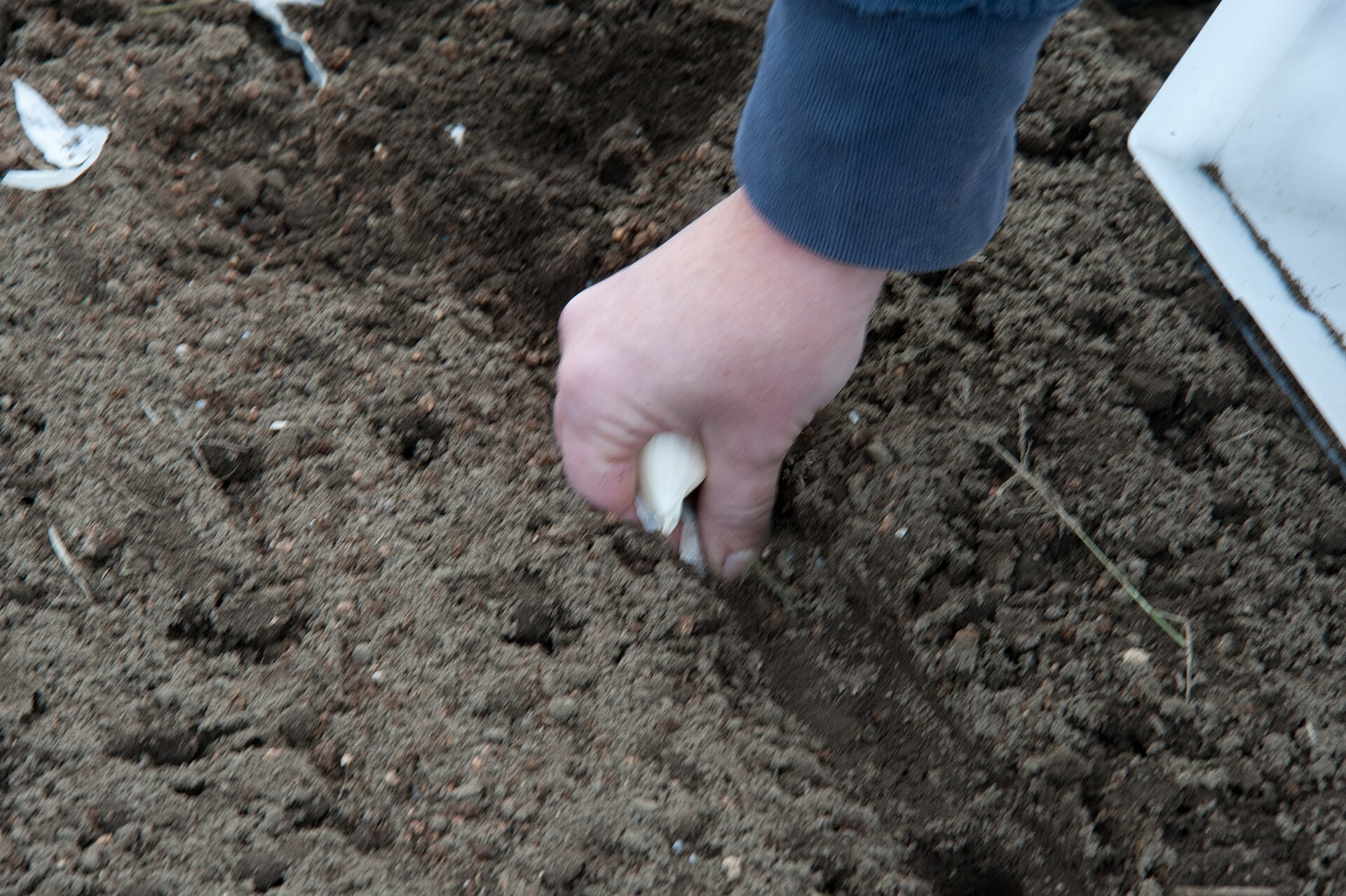
- Split the bulb. Gently break it into individual cloves just before planting. Use the biggest, healthiest cloves.
- Plant the right way up. Flat end (the base) down, pointed end up.
- Get the depth and spacing right. The RHS advises spacing cloves 15cm (6in) apart, with the tip 2.5cm (1in) below the surface. In light soil you can plant a little deeper for bigger bulbs, but don’t plant deeply in heavy soil.
- Cover against birds. Birds sometimes pull up newly planted cloves. A layer of fleece or plastic-free netting stops them until the roots take hold.
- Label it with the variety and planting date.
Looking after garlic through winter and spring
Garlic needs very little from you. Here’s what to keep on top of:
- Weeding. Keep the area weed-free so plants get full light. The RHS suggests hand-weeding, because a hoe can damage the shallow bulbs.
- Watering. Over winter, rain usually does the job for plants in the ground. Pots under cover or against a wall may need an occasional drink. In spring and early summer, water during dry spells to help the bulbs swell. Stop once the leaves start to yellow, as watering mature bulbs can cause rot.
- Flower stems. Snap off any flower stems as soon as they appear, so the plant’s energy goes into the bulb.
- Pots in hard weather. Raise containers onto pot feet or bricks so they drain, and move them to a sheltered spot during long freezing spells. Our guide to protecting potted plants from frost covers the options.
When is garlic ready to harvest?
The RHS says autumn-planted garlic is usually ready from late spring to early summer, once the leaves turn yellow. Lift gently with a fork, then dry the bulbs in a single layer somewhere warm and airy (but below 30°C) for two to four weeks before storing them somewhere cool and dry.
Frequently asked questions
When should you plant garlic in the UK?
From mid-autumn to early winter for most varieties, so October to December is typical. Some varieties are sold for late-winter and early-spring planting. Always check the packet.
Can you plant garlic in a pot?
Yes. Use a pot at least 25cm deep, filled with peat-free multi-purpose compost. Plant cloves 15cm apart with the tip 2.5cm below the surface, and water in dry spells.
Can you plant garlic in a raised bed?
Yes, and it’s a good choice if your garden soil is heavy or wet in winter, because raised beds drain better. Use the same spacing as in the ground.
When do you harvest garlic in the UK?
Autumn-planted garlic is usually ready from late spring to early summer, when the leaves turn yellow.
What to do now
If you have cloves in the shed or a packet on order, this week is a good time to plant them. Pick a dry day, choose your sunniest spot or your deepest pot, and get them in. Then you can more or less forget them until spring, when a little watering and weeding will see you through to harvest.
Related posts
- How to protect potted plants from frost and storms (UK)
- Winter container plants: 15 easy picks for UK pots
- Choosing the right soil for your vegetables
The Plantrella Team
Some links on this page are affiliate links. If you buy through them, Plantrella may earn a small commission at no extra cost to you. As an Amazon Associate we earn from qualifying purchases. Prices and availability shown in the product boxes come from Amazon and can change.
Photo credits
Featured image: “Planting the Garlic (6270333923)” by Dwight Sipler from Stow, MA, USA, licensed under CC BY 2.0, via Wikimedia Commons.
Sources
- RHS, “How to grow garlic” (grow your own guide), checked 15 November 2026: https://www.rhs.org.uk/vegetables/garlic/grow-your-own (planting window, cold requirement of one to two months at 0–10°C, supermarket garlic warning, hardneck vs softneck, recommended varieties, elephant garlic, pot depth 25cm, spacing and depth, modules for heavy soil, care, harvest, drying and storage)